The ideas that fill seats are not the most original ones
Event organizers who are new to community events often look for a format that nobody has done before. The instinct makes sense but the premise is wrong. Community events fill seats when they are relevant, accessible, well-promoted, and easy to attend, not when they are novel. The most successful local events run the same format year after year and grow each time because the community has come to expect them and values them. Originality is less important than reliability, and reliability is less important than execution.
That said, the format still matters. Some event ideas reliably attract community participation; others require resources or production complexity that outpaces what is realistically achievable for a local organizer. This guide covers ideas that work across different budgets, audiences, and time constraints, along with the decisions about ticketing and promotion that determine whether they fill seats.
Community event ideas by format
Quiz nights
The community quiz is one of the most reliable formats available to local organizers. It requires a venue with tables and chairs, a quiz host or willing volunteer, a microphone, and an entry fee. It scales comfortably from 30 to 200 people, works for almost any audience (adjust the question content to the crowd), and can be run as a charity fundraiser, a club night, or a standalone community social. Teams of four to eight are the natural unit, which means a single booking decision covers several attendees and group dynamics drive attendance. If one person in the group buys, they are likely to bring five others.
Prizes do not need to be expensive. A round for the winning team, a branded item, or a trophy with an ongoing challenge component (the team that holds the trophy defends it next month) can build loyalty and return visits without significant cost.
Outdoor markets and fairs
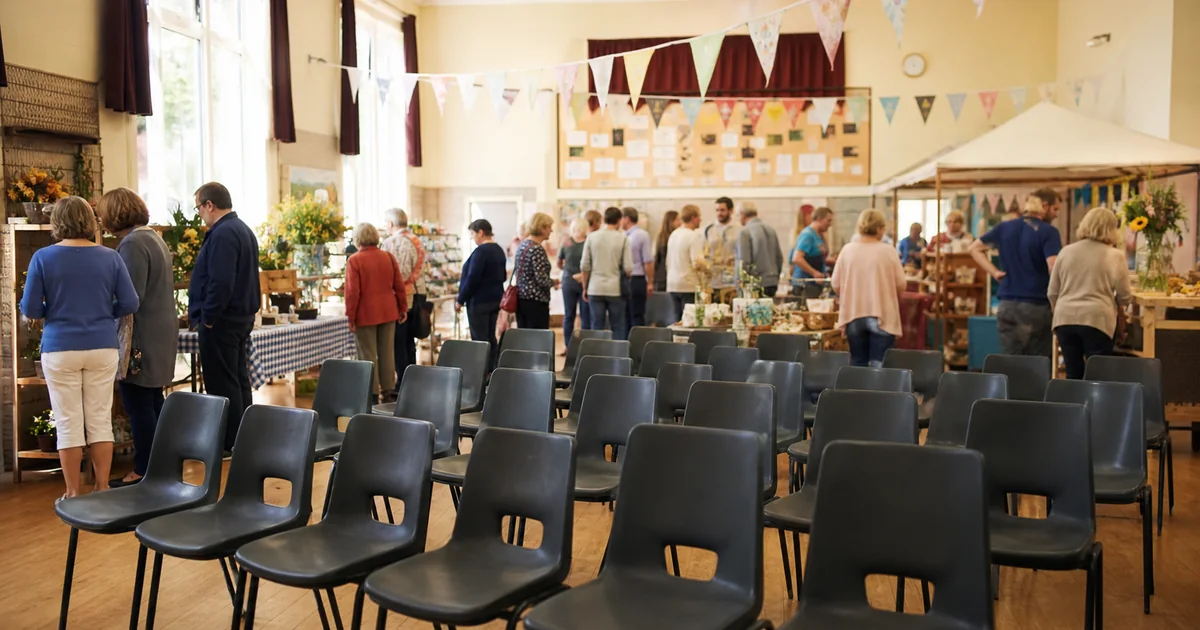
Community markets combine multiple draws into a single event: local makers, food vendors, entertainment, and a social destination. Their strength is that they do not require a single compelling headliner because the variety itself is the attraction. They also tend to attract broad demographic participation because they are accessible to families, older attendees, and people who would not otherwise attend a ticketed evening event.
The main challenge is logistics: permits for outdoor spaces, vendor management, weather contingency, and waste management. These are manageable but require genuine planning effort. Start with a smaller footprint and grow, rather than attempting an ambitious first edition that strains organizational capacity.
Community dinners and shared meals
A community dinner, whether it is a neighbourhood supper, a celebration of a cultural occasion, or a themed seasonal gathering, creates a different kind of connection than most event formats because the structure of sharing food builds conversation in ways that a conference or performance does not. Community dinners work particularly well for groups that are trying to build connection across boundaries: new residents in a neighbourhood, members of a faith community, supporters of a shared cause.
Ticketing a community dinner at a price that covers catering costs, or slightly above, is straightforward and well-accepted by most audiences. Pre-sold tickets also give you precise catering numbers, which reduces waste and controls costs more effectively than an open-door format.
Sports and active events
Community sport events, including five-a-side tournaments, fun runs, charity walks, cycling challenges, and fitness days, appeal to communities that are active or want to be more active. They tend to have low barriers to participation (no special skills required for a fun run), built-in social motivation (teams, running clubs, families), and strong charity alignment.
The participant is both the customer and the product. A local running event with 150 participants generates 150 people moving through a community space, which creates visibility and energy that passively attracts spectators and social media coverage. The event sells itself in a way that a seated entertainment event does not.
Cultural and seasonal celebrations
Events tied to cultural occasions, religious festivals, seasonal milestones, or local anniversaries have a built-in reason to exist and a ready-made audience in the community they celebrate. A Diwali night, a Christmas market, a summer solstice gathering, or an event marking a neighbourhood's anniversary all have a narrative hook that gives marketing a clear story and gives attendees a clear reason to be there beyond general entertainment.
These events also tend to attract media interest more easily than generic community events, because the cultural or seasonal angle is a ready-made story for local press and social content.
Performances and showcases
Local talent showcases, open mic nights, amateur theatre, spoken word evenings, and community band concerts serve a specific function: they give talented local people a platform and give their friends, families, and neighbours a reason to attend. The performer community drives ticket sales through their own networks in a way that the organizer does not have to replicate through advertising. An open mic with ten acts means ten performers promoting the show to their own audiences.
Keep entry barriers low for performers and audiences alike. A pay-what-you-can model or a modest admission often works better than a premium ticket price for this format, because the social dimension (supporting a friend or neighbour who is performing) is the primary driver of attendance rather than the show's own value as entertainment.
Workshops and skill-sharing
Community workshops, whether they teach a craft, a skill, a language, or a practical technique, offer something most entertainment events do not: participants leave having learned something tangible. This post-event value is a genuine differentiator that justifies higher ticket prices for the right audience and creates stronger word-of-mouth ("you should do this workshop, I learned to make my own X") than an event that was simply enjoyable.
The format also scales well at the small end. A workshop for 12 to 20 people in a community hall, a school room, or a café back room is a commercially viable community event that requires minimal production overhead. Recurring workshops with rotating topics build a community around the organizer that generates compounding returns with each new session.
\n\nBudget basics for small community events
\nMost community events have tighter budgets than their commercial counterparts, and many first-time organizers underestimate cost and then scramble when reality arrives. A simple budget framework helps: list every cost category before you spend anything, total the realistic estimate, then calculate what ticket income or grant funding covers it.
\nThe typical cost categories for a community event are: venue hire; AV and sound equipment if not provided by the venue; performer, speaker, or facilitator fees; catering or refreshments if provided; printing for posters and tickets; marketing costs; any licensing fees; and a contingency buffer of at least 10%. Many of these can be reduced significantly through donated services, volunteer labour, and in-kind contributions from local businesses, which is why sponsorship and supplier relationships are worth cultivating before the event, not just for the event itself.
\nA useful rule: if the event can break even at 50 to 60% capacity, it is financially resilient. If it requires 90% attendance to cover costs, a modest shortfall in ticket sales creates a significant financial problem. Price your tickets and manage your costs with the lower attendance scenario in mind, and treat strong attendance as the upside rather than the baseline assumption.
\n\nThe free vs ticketed question: when to charge
Many community event organizers are uncomfortable charging admission, either because the event is community-facing and charging feels exclusionary, or because they are not confident the event is worth the price. Both hesitations are understandable. Neither is a reason to default to free.
Free events have a significant no-show problem. Registrants who have made no financial commitment to attend are easy to forget about when the day arrives and something else comes up. A community event with 200 registered attendees and 70 who actually show up is a disheartening experience for the organizer and a poor experience for the minority who did come.
A modest admission fee changes this dynamic substantially. Even a nominal price creates enough of a psychological commitment that attendance rates improve meaningfully. It also gives you budget to improve the event: to hire a better venue, to pay a performer properly, to provide catering that attendees appreciate. The improvement in event quality that a small admission makes possible often generates more goodwill than the admission itself costs.
When free genuinely is right: events where access is a social good and exclusion on financial grounds would undermine the event's purpose; events funded by grants or sponsors that require open access; and events where your goal is maximum community participation and the commercial return is not a primary objective. For everything else, even a modest ticketed admission is worth considering.
Promoting in the channels that actually reach your community
Community event promotion works differently from large-scale event marketing because the target audience is not defined by interest or demographics but by geography and existing community membership. The channels that reach them are the ones already used by that community, not necessarily the channels with the largest theoretical reach.
Local Facebook groups are the most consistently effective digital channel for community events in most areas. A post in the local neighbourhood group, the parents' group, the residents' association page, or the local sports club group reaches a self-selected audience that is geographically relevant and already participating in community life. The tone should match the channel: conversational and personal, not promotional and polished.
Physical noticeboards in community centers, libraries, shops, schools, and religious spaces reach an audience that may not be active on social media at all, particularly older community members who are often among the most reliable attendees at community events. Print notices cost very little and remain visible for weeks without any ongoing effort.
Word of mouth through community connectors, individuals who are naturally well-connected across the community, such as school governors, local councillors, business association members, and faith community leaders, can reach groups that no amount of digital advertising will touch. A personal recommendation from a trusted local figure drives attendance in a way that a poster or a Facebook post does not.
For events using ShowRave, the event page link is shareable across every channel: a WhatsApp message, a Facebook post, an email, a text message, or a link printed on a physical flyer. Free registration through ShowRave gives you a guest list and allows reminder emails before the event, which reduces no-shows even for free community events where no payment is involved.
A note on realistic expectations for the first edition
Almost no community event sells out or generates maximum attendance in its first year. Community events build through repetition and reputation, and the first edition is almost always smaller than it will eventually become. The organizers who build the most successful long-running community events are the ones who run the first edition well, treat every attendee as a founding member, and announce the next edition clearly before people leave the first one. The second edition always has an advantage the first did not: a room full of people who have already experienced the event and know it is worth attending.