
Student audiences break every assumption about how ticket campaigns work
Every standard piece of event promotion advice assumes an audience that discovers events in advance, evaluates the options, and makes a reasoned purchasing decision. Student event audiences often do none of these things in that order. Discovery happens through a flatmate's message at 9pm. The purchasing decision is made in under a minute on a phone. And the commitment dissolves instantly if the checkout process requires more than two steps or loads slowly on a student Wi-Fi connection.
Getting student event ticketing right requires building for the buyer behavior that actually exists, not the behavior that would be convenient. This guide covers the specific ticketing and promotion setup that works for student and campus event audiences.
Price is the first filter, but it is not the deciding factor
Student events are overwhelmingly price-sensitive. The difference between a ticket that feels affordable and one that feels expensive is smaller in absolute terms for a student audience than for most other demographics. An Early Bird tier is therefore more effective for student events than for almost any other event type, because the saving represents a more meaningful proportion of the buyer's available spending and the deadline creates a specific decision point in an audience that otherwise procrastinates indefinitely.
Set the Early Bird allocation at a genuine quantity limit, configured as a number rather than a closing date. Student audiences respond to scarcity signals specifically because the social consequence of missing out is visible in their immediate community. When a flatmate has already bought an Early Bird ticket that is now sold out, the FOMO is immediate and the decision to buy at standard advance price follows quickly.
Free events still benefit from registration. A free campus event that sends a reminder to everyone who registered will see meaningfully higher attendance than one with an open-door format and no advance tracking. Registration converts the passive intent of "I might go" into the registered commitment of "I am going," which produces higher actual attendance even without a financial transaction. Free tickets on ShowRave include QR codes, attendee lists, and automated reminders at no cost to the organizer or attendee.
Where student audiences actually discover events
The promotion channels that drive student ticket sales are different from the channels that work for general consumer audiences. University-specific Facebook groups still have meaningful organic reach at many institutions, particularly for off-campus community events and events that attract a cross-year audience. WhatsApp group chats are the primary real-time communication channel for most student social planning: a message from one person to a group of ten produces direct, immediate decision-making in a way that a post to a general social feed does not.
Instagram is effective for awareness, particularly for events with strong visual identity: themed nights, performances, arts events, and anything with a distinctive aesthetic. TikTok has genuine organic reach for under-25 audiences and produces strong short-term spikes when content lands well, but it requires video content that is genuinely engaging rather than promotional. A 15-second clip of the event venue at capacity is more persuasive than a designed promotional graphic.
Discord communities serve specific student segments, particularly those organized around gaming, tech, creative disciplines, and specific university societies. For events targeting these communities specifically, a Discord announcement in the relevant server produces a more targeted response than broadcasting across general social channels.
Society-to-society affiliate links are the most efficient promotion channel for student events with a broad campus reach. Give each student society a unique affiliate link. When members of that society purchase through the link, the sale is attributed to the society. Some promoters offer complimentary tickets or a small discount to societies whose links generate a threshold number of sales. The combination of attribution and incentive converts passive society endorsements into active member promotion.
Timing: when student audiences actually buy
Student ticket buying follows patterns that experienced student event promoters learn to account for. Sales volume is lowest immediately after the launch announcement, builds slowly through the first week, accelerates in the final three to four days before the event, and produces a last-night surge that accounts for a disproportionate share of total sales for many student events.
This pattern means the Early Bird allocation needs to close early enough to generate social proof before the general sale opens, the general advance period needs a mid-campaign urgency moment (a price rise announcement or a remaining ticket count post) to prevent the sales plateau from lasting too long, and the door price needs to be high enough above the advance price to incentivise the last-minute buyers to buy online the night before rather than paying at the door.
For recurring student events that run across a term or academic year, the pattern improves across editions as the event builds a reputation. The second edition of a student night that sold out its first run will launch with a different buyer psychology: people who missed out last time are specifically motivated to buy earlier. Use this dynamic actively in the promotion: reference the sell-out from the previous edition in the launch communication to the audience who was there and to the audience who missed it.
The DP Generator for campus social identity
Student communities have an unusually strong relationship between social identity and event attendance. Going to specific events, or being known to go to specific events, is part of the social fabric of campus life for many students. The DP Generator at/dp-generatorconverts this identity dynamic into promotion: buyers who update their profile picture with the event's branded frame tell their entire campus-based social network that they are attending.
For student events, the DP Generator is particularly effective because the audience is densely networked in a small geographic community. When 30 students who are all in overlapping social networks update their profile pictures with the same event frame, the reach compounds rapidly across mutual connections. A buyer who sees five of their friends' profiles all showing the same event frame experiences a concentrated social proof signal that broad advertising cannot replicate.
Share the DP Generator link in the ticket confirmation email and in the society group chats alongside the affiliate links. Students who buy early and update their profiles before the event become ambient promotion for everyone in their network who has not yet bought.
Check-in for student events
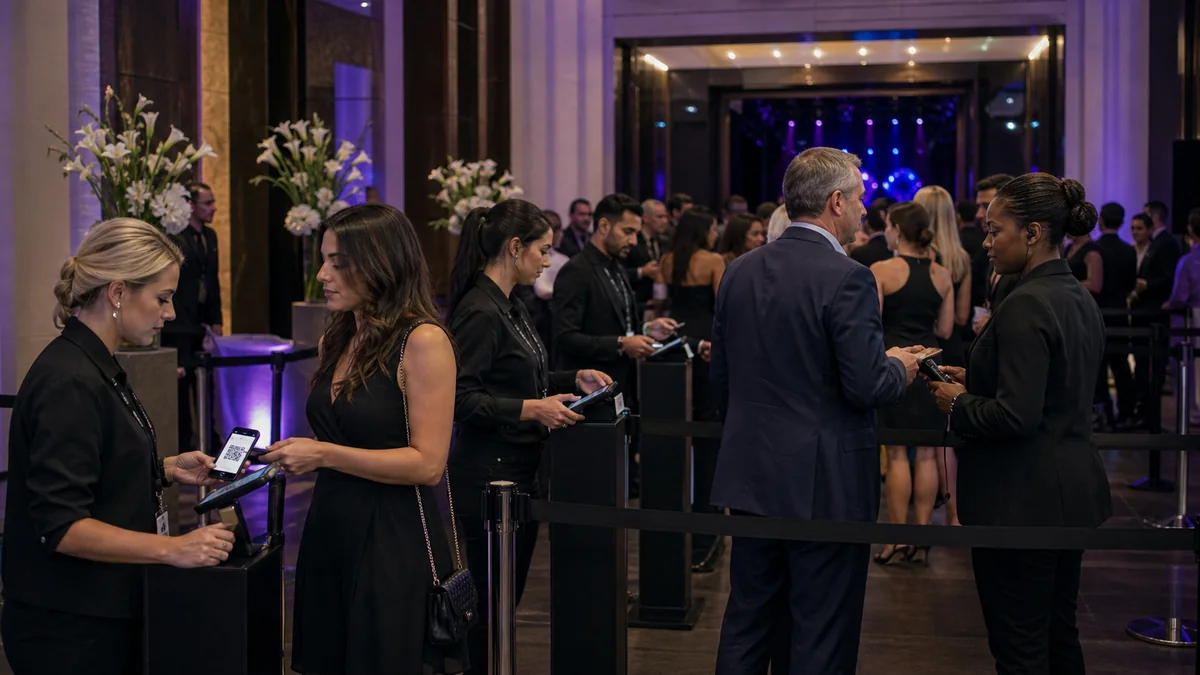
Student event check-in has a specific operational challenge: a high proportion of attendees arrive close to the same time, at or just after the advertised doors time, and the crowd at the door builds quickly from nothing to peak within a short window. Entry lane configuration needs to match this pattern, not the average arrival rate across the full evening.
Download the ShowRave scanner app at/apps/scanneron multiple devices if the event has more than 150 expected attendees. A single scanner device that processes efficiently in isolation creates a bottleneck the moment two or three groups arrive simultaneously. Two devices with a briefed operator at each can handle the peak arrival volume without a queue building.
Student audiences have their tickets in screenshots, email attachments, or Apple Wallet passes. The ShowRave scanner reads all of these identically. Brief the door team that the specific format does not matter: any presentation of the QR code scans the same way. This removes the most common source of door confusion at student events, which is operators who ask buyers to "find the email" when a screenshot would work just as well.
Society and club events: the recurring program that builds a campus following
Student societies and university clubs run the majority of campus events. The model is different from a one-off event: the same audience returns edition after edition, the organizer team changes year by year as students graduate, and the event's reputation is the primary acquisition asset rather than any individual organizer's personal network.
For recurring society events, retaining the attendee list from each edition is the infrastructure that makes the next edition easier to sell. A society that has run monthly socials for two years and retained the ShowRave attendee export from every edition has a database of campus community members who have demonstrated they attend this type of event. The outgoing committee that passes this database to the incoming committee gives them a promotional asset that a committee starting from scratch does not have.
Build the handover of attendee data into the society's annual committee transition process. The data is not personal to the outgoing committee; it belongs to the society and serves its ongoing event program. Treating it as institutional asset rather than individual property is the operational discipline that compounds the value of a recurring event program across multiple years of student turnover.
University-organized versus student-organized events
Events organized directly by the university, by a faculty, or by a student union have a different promotional context from events organized by student societies or individual students. University-organized events benefit from official communication channels: the student portal, official email lists, and direct communications from faculty or administration. These channels have reach and credibility that individual student promoters cannot replicate.
For university-organized events, ShowRave's registration and check-in infrastructure serves the same operational functions as for any other event: structured registration, dietary and accessibility data capture, QR check-in, and post-event attendance reporting. The post-event report from a university-organized event is often required by the organizing department to demonstrate participation for reporting purposes, and the ShowRave export provides this data in a format that is immediately usable for institutional reporting without manual compilation.
For student-organized events that sit outside official university channels, the promotion challenge is reach rather than credibility. The affiliate link and DP Generator combination gives student promoters tools that extend their reach through peer networks in a way that is organically suited to the campus social dynamic. A student who is promoting an event through their personal social network is a more trusted source for their peers than any official communication, which is why student-to-student promotion through affiliate links consistently outperforms broadcast promotion from the organizer alone.
\n\nEvery student event, from the first edition of a new society social to a long-running annual ball, operates in the same social environment: a dense, trust-based campus community where personal recommendation travels faster and converts better than any form of advertising. Build your ticketing setup to capture that dynamic rather than fight it, and the platform will consistently outperform the promotional budget that attempts to replace it.