Box office systems were not designed for how independent events actually work
Traditional box office infrastructure was built around a specific operating model: a permanent venue with a fixed schedule, a ticketing department, long lead times for event setup, and a revenue share arrangement where the venue and the box office operator take a cut of every ticket sold. That model works for a West End theatre running the same show six nights a week or a stadium selling season tickets to an established fan base. It does not work for an independent promoter running a 300-person show, a festival organizer building an audience across three years, or a community venue running one-off events without a dedicated ticketing team.
The gap between what legacy box office infrastructure assumes and what independent organizers actually need has widened as event production has become more accessible. Recording equipment, live streaming, and event venues are available to organizers at any scale. But the ticketing infrastructure many independent promoters are still using, or being asked to use by venues, was designed for a different era and a different operational model.
This post covers what independent event organizers actually need from a ticketing system, why legacy box office infrastructure often does not deliver it, and what a modern organizer-first platform provides instead.
What legacy box office systems assume about how you operate
Legacy box office systems typically assume that the organizer has a dedicated team managing the event across a long lead time. The setup process is built for a ticketing department, not a solo promoter who is also managing the venue, the performers, the marketing, and the door staff. Configuration is often complex, requires training, and produces an event page that looks like it came from a box office software system rather than from the event's own identity.
They also often assume a revenue sharing model that removes a percentage of ticket income regardless of the services actually used. In a traditional box office arrangement, the venue owns the ticketing relationship, not the organizer. The attendee list may belong to the venue. The post-event data may not be exportable in a form the organizer can use for future events. The promoter fills seats and the venue captures the audience relationship.
For a touring artist building an audience across multiple venues and cities, losing the audience relationship with every ticketing arrangement is a significant commercial cost. For a recurring promoter who wants to build a mailing list from attendees, an architecture where the buyer data belongs to a venue's box office is a meaningful constraint.
What independent organizers actually need
The requirements are simpler than legacy systems often imply. An independent event organizer needs: a way to create an event page that represents their event's identity rather than a platform's interface; a ticket configuration that handles multiple tiers with independent capacity limits; a checkout that does not add unexpected fees for the buyer; a scanner app for entry management without additional hardware or staffing; an attendee list that belongs to the organizer and is exportable in full; and a payout that reaches the organizer rather than flowing through a venue arrangement.
These requirements are not advanced. They are the baseline of a functional ticketed event operation. Modern organizer-first platforms provide all of them as standard without the setup complexity, revenue sharing, or audience ownership constraints of legacy box office arrangements.
The audience ownership question
Every ticket sold through a legacy box office arrangement generates an attendee record. The question is: who owns that record? In many traditional arrangements, the venue's ticketing system is the system of record. The promoter gets a headcount and perhaps a name list, but the ongoing relationship with that buyer, the email address, the purchase history, the communication channel, remains in the venue's infrastructure.
In an organizer-first model like ShowRave, the buyer relationship flows directly to the organizer. Every buyer provides their details to the event, and those details are available to the organizer in a full, exportable attendee list immediately after purchase. The organizer owns the audience data they generate, which is the foundation of every subsequent event's promotion.
This distinction compounds over time. An organizer who has run fifty events through legacy box office arrangements has generated thousands of ticket sales but may have built very little of a directly owned audience. An organizer who has run the same fifty events through an organizer-first platform has built a database of verified buyers that represents years of audience development. That database is one of the most durable commercial assets an independent promoter can build, and it is only available through systems that give the organizer control of the buyer relationship from the first transaction.
Setup complexity and operational independence
Legacy box office systems often require venue staff involvement to configure an event. The promoter provides the event details; a ticketing team or venue administrator creates the listing; the promoter reviews it. This multi-step process creates dependencies that slow down event launches and reduce the promoter's ability to respond quickly to opportunities.
ShowRave allows the organizer to create, configure, and publish an event without any intermediary involvement. The event page, ticket tiers, AddOns, affiliate links, and capacity limits are all configurable directly by the organizer. A new event can be live and selling tickets within an hour of the decision to run it. The setup is the organizer's own work, which means it reflects their event's identity rather than a venue's template.
For recurring promoters or agency-managed events where multiple events need to be active simultaneously, the ability to manage everything from a single organizer account, with each event maintaining its own separate attendee list and configuration, is a significant operational improvement over box office arrangements where each venue relationship is a separate system interaction.
Scanner and entry: removing the hardware dependency
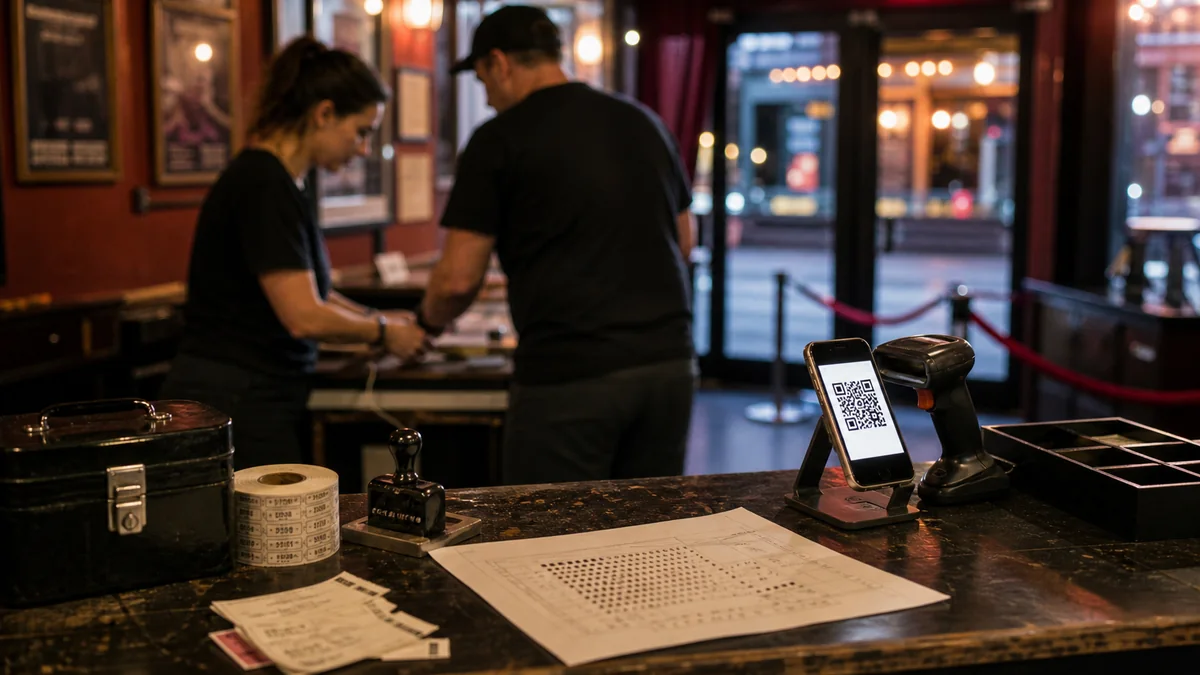
Traditional box office entry systems often involve dedicated hardware: barcode scanners, turnstile systems, or box office terminals that require physical infrastructure at the venue. For independent promoters using different venues for different events, this means either renting equipment per event, relying on the venue's existing infrastructure (which may be incompatible with your ticketing system), or improvising with printed lists.
The ShowRave scanner app, available for iOS and Android at/apps/scanner, turns any smartphone into a QR scanner that validates tickets against the event's attendee database in real time. It works offline, supports multiple simultaneous devices, and requires no additional hardware beyond devices the door team is already carrying. For an independent promoter who changes venues every month, this mobility is the difference between an entry operation that works at every venue and one that requires a different technical conversation with every room.
Revenue flow and payout timing
Legacy box office arrangements typically involve a settlement process: the venue box office collects ticket revenue on the event's behalf, deducts its fees, and settles the balance to the promoter after the event. This creates a cash flow gap between when tickets are sold and when the organizer receives the money, which can be weeks after the event closes.
ShowRave's payout arrangements, detailed at/payment-and-payout, allow organizers to receive payouts on a rolling basis rather than waiting for a post-event settlement. For independent promoters whose pre-event costs, venue deposits, performer guarantees, and production hire, are funded from ticket revenue, the ability to access that revenue before the event opens changes the financial planning of every event they run.
What independent promoters gain from the transition
Organizers who move from legacy box office arrangements to organizer-first ticketing consistently describe the same practical gains. They own their audience for the first time. Their event pages look like their events rather than like a box office template. They can configure and update tiers, add promotional codes, and activate affiliate links without involving a third party. They receive their money faster. And they have a post-event data set they can actually use for the next event's promotion.
The transition requires learning a new system, but the learning curve for modern ticketing platforms is measured in hours rather than days. The operational independence and commercial control gained in exchange is compounding: every event run through an organizer-first system builds a stronger foundation for the next one, in ways that legacy box office arrangements, by design, do not.
Review ShowRave's organizer-first model at/sell-tickets-onlineand/pricing.
\n\nThe promoter who builds equity in their own audience
There is a meaningful difference between an event promoter who runs events and an event promoter who builds an audience. The first fills rooms event by event, starting from a similar position every time. The second builds a compounding asset: a database of buyers who have already proven they will pay to attend, available to activate for every subsequent event.
Legacy box office arrangements make the first type of promoter easier to operate. The infrastructure is there, the venue handles the ticketing, the promoter focuses on the show. But they do not support the second type of promoter, because the audience relationship is not the promoter's to own.
Modern organizer-first ticketing makes the second type of promoter possible from the very first event. Every buyer who goes through ShowRave is added to the organizer's exportable attendee list, available for direct contact for every subsequent event. The promoter who uses this consistently across a few years builds a promotional channel that outperforms any advertising equivalent at a fraction of the cost, because they are reaching people who have already made the decision once and are the most likely to make it again.
That is the structural advantage of organizer-first ticketing over legacy box office arrangements. It is not just about the features or the cost. It is about whether the infrastructure you use is building your business or the venue's.
\n\nThe first step is simple: run the next event through an organizer-first platform. Export the attendee list afterwards. Use it to promote the event after that. The compounding starts from the first event that was set up correctly.
\n\nFor independent promoters ready to move beyond legacy box office dependencies, creating an organizer account on ShowRave and running the next event through it costs nothing to try on a free event. The platform comparison with any existing box office arrangement becomes obvious once the attendee data, the payout timing, and the operational independence are experienced directly rather than described in the abstract.