
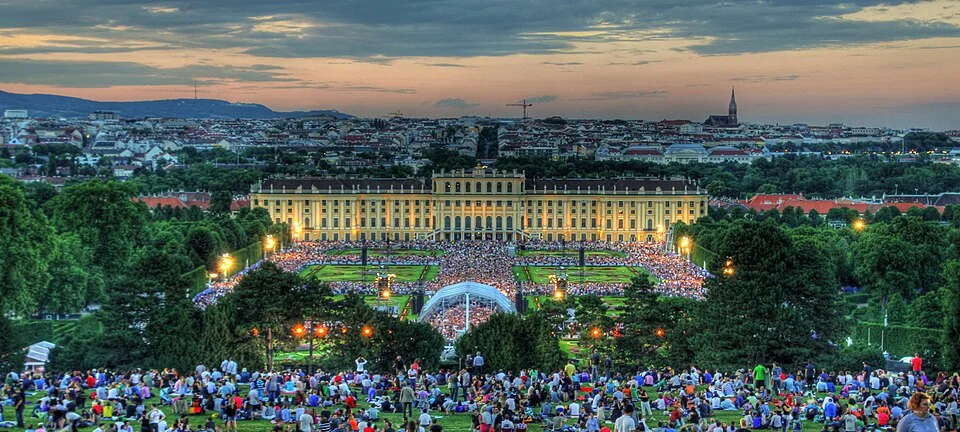
Austria carries one of the most concentrated cultural inheritances in European history. Vienna was, for centuries, the capital of an empire that encompassed most of Central Europe, and that historical weight is present in its architecture, its institutions, and its cultural ambitions. The music that was composed in Vienna by Haydn, Mozart, Beethoven, Schubert, Brahms, Mahler, and Bruckner represents arguably the greatest concentration of musical genius in a single city in history. That legacy is actively maintained today through institutions and events that take their responsibilities seriously. Salzburg and Graz add distinct contributions of their own to a country that is small in size but enormous in cultural density.
Classical Music and Opera
Vienna is the classical music capital of the world, and that claim is supportable by any reasonable measure. The Vienna Philharmonic Orchestra, the Vienna Symphony Orchestra, and the orchestras associated with major opera houses collectively represent a concentration of orchestral excellence that has no parallel. The Vienna State Opera programs year-round with a repertoire and casting standard that makes it the most important opera house in the world for many in the field. The Musikverein, home to the Vienna Philharmonic and famous for the acoustic perfection of its Golden Hall, hosts the New Year's Concert that is broadcast to over fifty million television viewers internationally. The standing-room tickets available at both the State Opera and the Musikverein represent some of the most extraordinary value in cultural life anywhere: a few euros for a same-day place to hear some of the finest musical performances in the world.
Coffeehouse Culture and Nightlife
The Viennese coffeehouse is a UNESCO Intangible Cultural Heritage and one of the most distinctive social institutions in European life. The great Vienna coffeehouses, including Cafe Central, Cafe Landtmann, Cafe Hawelka, and dozens of others, are not cafes in the ordinary sense but social spaces where you can sit for hours with a single Melange (the Viennese take on a cappuccino), reading the newspapers provided on racks, meeting people, or simply watching the life of the city. These institutions were the intellectual and creative centers of Viennese life for centuries, frequented by figures including Freud, Klimt, Trotsky, and Musil, and they continue to function as genuine social spaces rather than tourist attractions. Vienna's nightlife extends well beyond the coffeehouses, with a strong club scene in the Naschmarkt area and along the Gurtel, where old railway arches have been converted into bars and clubs.
Art, Museums, and Heritage
Vienna's cultural institutions reflect the accumulated wealth and ambition of a former imperial capital. The Kunsthistorisches Museum holds one of the greatest art collections in the world, assembled by the Habsburg rulers and including major works from ancient Egypt through the Renaissance. The Belvedere Palace contains the world's largest collection of Gustav Klimt's paintings, including The Kiss, which is one of the most visited artworks in Austria. The Leopold Museum focuses on Austrian Expressionism and holds the world's largest collection of Egon Schiele's work. The Museum of Natural History, facing the Kunsthistorisches across the Maria-Theresien-Platz, holds significant collections including the Venus of Willendorf. The Albertina holds one of the most important collections of graphic art in the world. Sigmund Freud's apartment, the Spanish Riding School where Lipizzaner stallions perform classical dressage, and the Habsburg imperial crypt all add to a cultural density that is overwhelming in its richness.
Food and Wine
Austrian cuisine is hearty, technically skilled, and reflects the influence of the many cultures that passed through the Habsburg empire. Wiener Schnitzel, a thin veal cutlet coated in breadcrumbs and pan-fried, is the national dish and is made with a precision and quality in good Viennese restaurants that bears no resemblance to the international imitations. Tafelspitz, boiled beef served with various accompaniments, was reportedly Emperor Franz Joseph's favorite dish. Sachertorte, the dense chocolate cake with apricot jam and chocolate glaze created at the Hotel Sacher in 1832, is still made there to the original recipe and is genuinely excellent. Austrian wine, particularly Gruner Veltliner and Riesling from the Wachau and Kamptal regions, represents some of the finest white wine in the world and is largely unknown internationally. The wine taverns (Heurigen) on the outskirts of Vienna, where young wine is served with food in garden settings, are one of the most pleasant ways to spend an afternoon.
Skiing and Outdoor Life
Austria's alpine skiing infrastructure is among the finest in the world. The Arlberg region, encompassing St Anton and Lech, is considered by many serious skiers to be the best ski terrain in the Alps. Kitzbuhel, home to the Hahnenkamm Downhill, the most prestigious race in alpine skiing, has a particular cachet. Innsbruck and its surrounding mountains hosted two Winter Olympics and maintain infrastructure that makes them accessible. The Austrian ski tradition is deep: Austria has produced more world-class alpine ski racers per capita than any other country, and the culture of skiing as an everyday activity across the alpine regions is deeply embedded. Summer in the Austrian mountains brings hiking, mountain biking, and via ferrata on well-maintained trail networks with mountain huts providing overnight accommodation.
Festivals and Events
Austria's festival calendar is anchored by events that reflect its cultural heritage. The Salzburg Festival, held every July and August, is one of the most prestigious classical music and drama festivals in the world: founded in 1920, it draws the greatest conductors, directors, and performers to a program that spans opera, orchestral concerts, recitals, and theatre in a setting of Habsburg-era architectural grandeur. The Vienna Opera Ball in February is the most formally magnificent of Vienna's hundred-plus annual balls, a tradition of costumed dancing events that goes back to the imperial era and continues as a genuinely attended social institution. The Vienna Silvesterpfad on New Year's Eve transforms the inner city into a series of outdoor performance spaces, making Vienna one of the finest places in the world to celebrate the new year. Christmas markets in Vienna and across Austria are among the most atmospheric in Europe.