
The organizer who cannot delegate is not building a business
There is a version of event organizing that looks successful from the outside and is quietly unsustainable on the inside. The organizer is across everything. They approve every change to the event page. They personally handle every buyer message. They are the one at the door on the night, the one chasing the venue on the morning of, the one checking the ticket sales dashboard at midnight. They have a team in name but not in practice, because nothing actually moves without them.
This is not a character flaw. It is usually what happens when the tools you are using do not support genuine delegation. If every team member logs in through the same account, if there is no way to assign specific events to specific people, if your finance data and your event management live in the same place with the same access, then handing something off to a team member does not really mean handing it off. It means hoping they do not accidentally touch something they were not supposed to, and being available to answer questions because there is no structure to guide them.
Genuine delegation requires genuine structure. It requires knowing that when you assign someone to manage an event, they can do what they need to do and nothing beyond it. It requires a platform that reflects the way your team actually works, not one that assumes everything is handled by one person and asks everyone else to navigate around that assumption.
Event teams have real divisions of responsibility
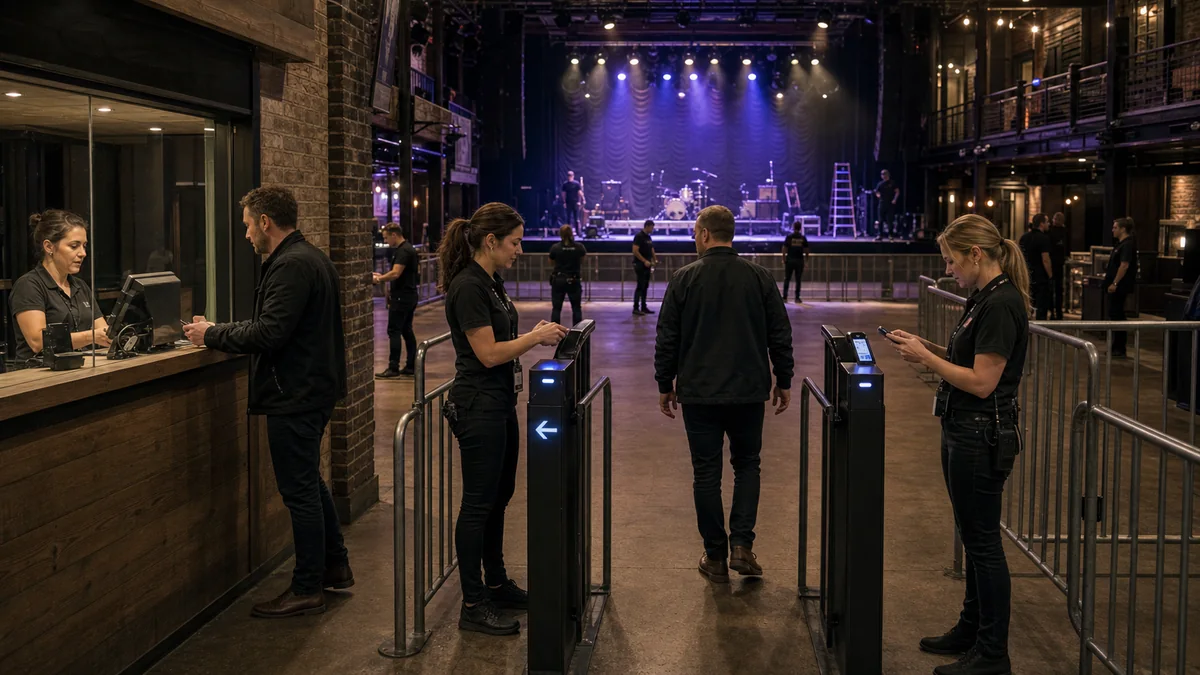
A working event team is not a group of people doing the same job. Different people carry different parts of the operation, and those divisions are meaningful. The person coordinating the venue and logistics is not the same person handling buyer enquiries. The person managing on-the-night door operations is not the same person who controls payouts. The person building the event page and running the marketing is not the person who needs access to transaction records.
These divisions exist because events are genuinely complex operations that span multiple competencies. A well-run event company has people who are good at different things and whose time is spent on those things rather than on everything at once. That is what makes it possible to run more events, larger events, and events that do not depend on one person being everywhere simultaneously.
For agencies, this division runs even deeper. An agency running events for multiple clients has team members whose work is client-specific. A coordinator working on one client's conference should not be able to see another client's attendee list or revenue figures. The separation of access by event and by role is not a nice-to-have in that context. It is the basic condition under which an agency can take on multiple clients without those clients' operations bleeding into each other.
The problem is that most ticketing platforms are not built for this. They are built around a single organizer account, which works well enough when one person is doing everything and falls apart the moment a team is involved. There is no mechanism to say that one person is responsible for this event and another is responsible for that one. There is no way to give a team member the access they need for their specific role without giving them access to everything else as well. The platform treats the team as if it does not exist.
Assigning work and assigning access are two different things
Most event teams get around the platform's limitations by assigning work verbally or through a project management tool sitting alongside the ticketing account. The coordinator knows which events they are looking after. The finance lead knows they are the one handling payouts. The door manager knows to log into the scanner app on the night. These assignments exist in people's heads and in Slack threads, not in the platform itself.
The gap between work assignment and access assignment is where things go wrong. When something breaks, the platform cannot tell you who was working on it because every action looks the same regardless of who performed it. When two people make conflicting changes to the same event, there is no record to arbitrate between them. When someone new joins the team, there is no way to bring them in cleanly without giving them everything from the first login.
Proper access assignment means the platform knows what each person on your team is responsible for. It means that when someone logs in, they see the events and the tools relevant to their role, and the boundaries of that role are enforced by the system rather than by convention. The coordinator does not need to remember not to touch the payout settings because the payout settings are not part of their access. The boundary is real, not instructional.
This is not a feature that matters for the organizer running one event a year. It is the feature that makes running multiple events at the same time, across a team with different responsibilities, actually workable rather than a constant coordination overhead.
What changes when your team can operate independently
The clearest sign that a team is genuinely operational rather than nominally assembled is that work happens when the lead organizer is not available. An event page gets updated. A buyer enquiry is handled. The guest list is checked before doors open. All of it happens because the team member responsible for it has the access, the clarity, and the confidence to act without waiting for approval.
That confidence comes directly from how access is structured. A team member who knows exactly what they have permission to do, and who can see that their access is scoped to their actual role, operates with much less hesitation than someone navigating a shared account and wondering what they should and should not be touching. The former feels like a job with clear ownership. The latter feels like a borrowed login and a set of conventions that may or may not hold.
The organizer who builds a team that can operate independently gains the most valuable thing in event operations: the ability to run more than one thing at once. When your team does not need you in the room for every decision, you can be across multiple events in a way that is simply not possible when everything routes through you. That is the difference between an organizer who runs events and an event organization that runs at scale.
Control and delegation are not opposites
There is a version of growth that stalls not because demand runs out but because the organizer behind the operation cannot physically manage what the business is producing. They are at capacity. Another event would mean something else suffers. Another team member would mean another variable to manage in a system that already has too many. The organization does not grow because the person at the center of it cannot be in more than one place, and the tools they are using are not helping.
The concern that comes up most often when organizers think about opening up account access is loss of control. If team members can log in independently, can they make changes that should not be made? Can they access data they should not see? Can something go wrong at the platform level that would not have gone wrong with a single-person account?
The answer depends entirely on how the access is structured. Giving a team member access to everything is not delegation. It is abdication. Giving them access to exactly what their role requires, within a system that enforces those boundaries and logs every significant action, is delegation. The organizer who does the latter is more in control of their operation, not less, because they know who is doing what and have a record to refer to when something needs reviewing.
Retaining owner-level control over finance, bank account settings, and payout management while giving event managers the access they need to run events is not a compromise. It is exactly the right model for a professional event operation. The owner stays accountable for money. The team stays responsible for operations. Neither has to step into the other's territory, and neither can by accident.
ShowRave Organization Workspaces
ShowRave's organization workspace is the infrastructure that makes this kind of team possible. An organization on ShowRave has a defined owner with full account control, including finance and payout settings that are not accessible to other team members. Team members are brought in through a secure invite flow, given a role that reflects what they need to do, and assigned to the events they are responsible for managing.
From that point, each team member operates within their scope. They see what they need to see. They can do what their role permits. They cannot accidentally alter settings or access data outside their assigned area. The owner sees across the entire organization, including an audit trail that records significant actions by team member. When something needs reviewing, the record is already there.
Inviting someone into the organization does not require handing over a password or explaining what they should and should not look at. The invite goes out by email. The recipient accepts through a secure link. From that point, their access is defined by their role, and what they can see and do in the platform reflects exactly that. There is no onboarding conversation about which parts of the account to avoid. The structure does that work instead.
For event agencies, this is what makes it possible to manage multiple client accounts without confusion about who is working on what.
For venue teams, it is what separates the finance function from the event management function at the platform level, rather than just in policy. For growing event companies, it is the infrastructure that lets the operation scale without the lead organizer becoming the bottleneck for every decision.Building a team that runs without you does not mean stepping back from your event business. It means building it properly. The tools you use either make that possible or they do not, and the platform you run your events on is one of the most consequential choices in that build.