
Things To Do in Munich Germany

Discover events, experiences, and everything the city has on offer in Munich. Browse the full event calendar or read the guide below.

Things To Do in Munich

Discover events, experiences, and everything the city has on offer in Munich. Browse the full event calendar or read the guide below.

Beer Halls, the Oktoberfest and Bavarian Culture

Munich's beer culture is the most institutionalised in the world: the Hofbräuhaus, originally built in 1589 as the royal brewery of the Wittelsbach dynasty, is the most famous beer hall in existence and operates at scale, seating several thousand people in its ground floor hall, beer garden, and upper rooms. The city's six major breweries (Augustiner, Hofbräu, Paulaner, Hacker-Pschorr, Spaten, and Löwenbräu) each maintain their own beer halls and gardens, and the beer garden culture of the English Garden, the Chinesischer Turm, and the Augustiner-Keller represents a summer social institution unique to Munich. The Oktoberfest, held on the Theresienwiese for the last two weeks of September and first week of October, is the largest public festival in the world, drawing seven million visitors to consume beer, consume roasted chicken and pretzels, and ride funfair attractions in a temporary city of tents erected annually.

Engineering, Industry and Economic Strength

Munich is the headquarters of some of Germany's most globally significant companies: BMW, Siemens, MAN, and Allianz have their principal operations here, and the city is the economic capital of Bavaria, the wealthiest of Germany's federal states by GDP per capita. The BMW World visitor center and the BMW Museum adjacent to the four-cylinder headquarters tower are major attractions in their own right and reflect a corporate self-confidence that treats its own industrial history as a cultural asset. Munich's trade fair complex (Messe München) is one of the largest in the world and hosts the electronica, productronica, and bauma (construction machinery) fairs, which are the most significant events in their respective industries internationally. The city's position as Germany's third-largest city belies its economic weight, which is disproportionate to its population.

Alpine Gateway and Outdoor Life

Munich is the closest major city to the Alps, and the mountains are visible on clear days from the city's rooftops and parks, appearing with a clarity that surprises visitors accustomed to urban horizons. The Zugspitze, Germany's highest peak at 2,962 metres, is reachable from Munich by suburban train in under two hours. The ski resorts of Garmisch-Partenkirchen, the Zugspitze glacier, and the Bavarian Alps are accessible as day trips in winter, making Munich a city where skiing is a normal component of a winter weekend rather than an annual expedition. Lake Starnberg and the Ammersee, thirty minutes south, are the summer bathing destinations for Munich residents. The English Garden (Englischer Garten), at 3.7 kilometres in length one of the largest urban parks in the world, contains a stretch of the Eisbach canal where artificial waves allow urban surfing year-round.

Architecture, Palaces and Baroque Heritage

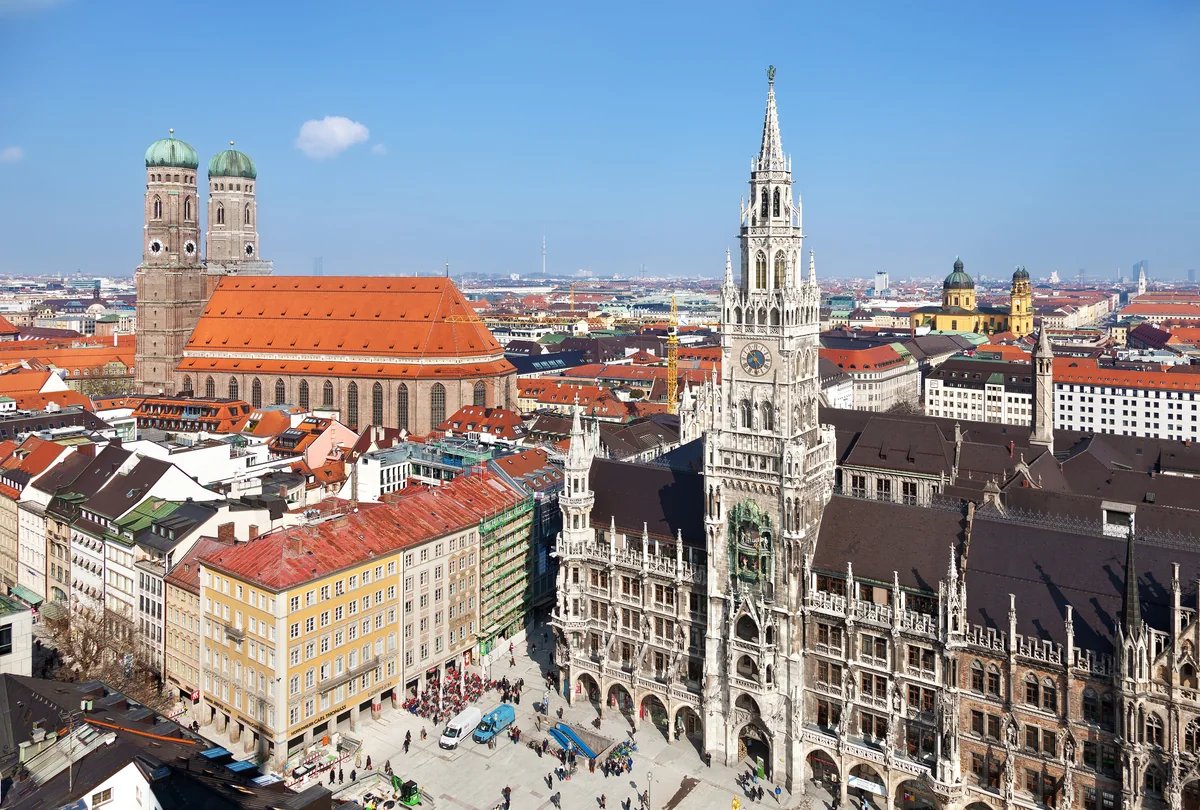
Munich's architectural character is Baroque and Neoclassical rather than Gothic or medieval, shaped by the Wittelsbach dynasty's building program from the seventeenth century onward and then by the Neoclassical city planning of the early nineteenth century. The Residenz, the former royal palace in the city center, is the largest palace complex in Germany and contains a sequence of state rooms, a treasure chamber, and a court theatre of extraordinary quality. The Nymphenburg Palace to the west of the city, with its formal gardens, canals, and outlying pavilions, is the most complete surviving Baroque palace complex in Germany. The Frauenkirche with its twin onion domes defines the skyline of the old city. The Pinakotheken museums on the Kunstareal (art quarter) include the Alte Pinakothek (Old Masters), Neue Pinakothek (nineteenth century), and Pinakothek der Moderne, forming one of the most significant art museum complexes in Europe.

Culture, Festivals and the Munich Arts Calendar

Munich's cultural calendar extends well beyond the Oktoberfest that defines it internationally. The Tollwood Winter Festival, held on the Theresienwiese in December, is a sustainable market and performance venue drawing several hundred thousand visitors to a program of world music, theatre, and quality food producers that positions itself as the cultural counterpart to the beer festival. The Munich Film Festival in June and July is the largest publicly accessible film festival in Germany, with screenings across cinemas and open-air venues through a two-week program. The Residenztheater and the Bavarian State Opera are the city's principal classical performing arts institutions, both of international standing, and the annual opera festival in July draws audiences from across Europe for productions in the State Opera house and the Cuvilliés Theatre, the finest surviving Rococo theatre interior in the world. The Munich Philharmonic performs at the Gasteig in a program of year-round concerts that sustains a classical music culture rooted in the city's history as the Wittelsbach dynasty's preferred seat. The Pinakotheken museums on the Kunstareal receive around 600,000 visitors annually across their three buildings covering Old Masters, the 19th century, and contemporary art. The Deutsches Museum on an island in the Isar, the world's largest science and technology museum by collection size, takes an entire day to navigate properly and is among the most underrated major museums in Europe. The Christmas market on the Marienplatz and the surrounding squares, held through Advent, draws several million visitors to a city that has elevated seasonal celebration to a civic art form.

More Cities in Germany
Ready to find events in Munich?

Browse concerts, club nights, festivals, cultural events, and more. Book directly with the organizer.

Running an event in Munich? Create a free listing
Browse Events in Munich